Halina Prugar-Ketling with the Platinum Lions at the 51st PFF
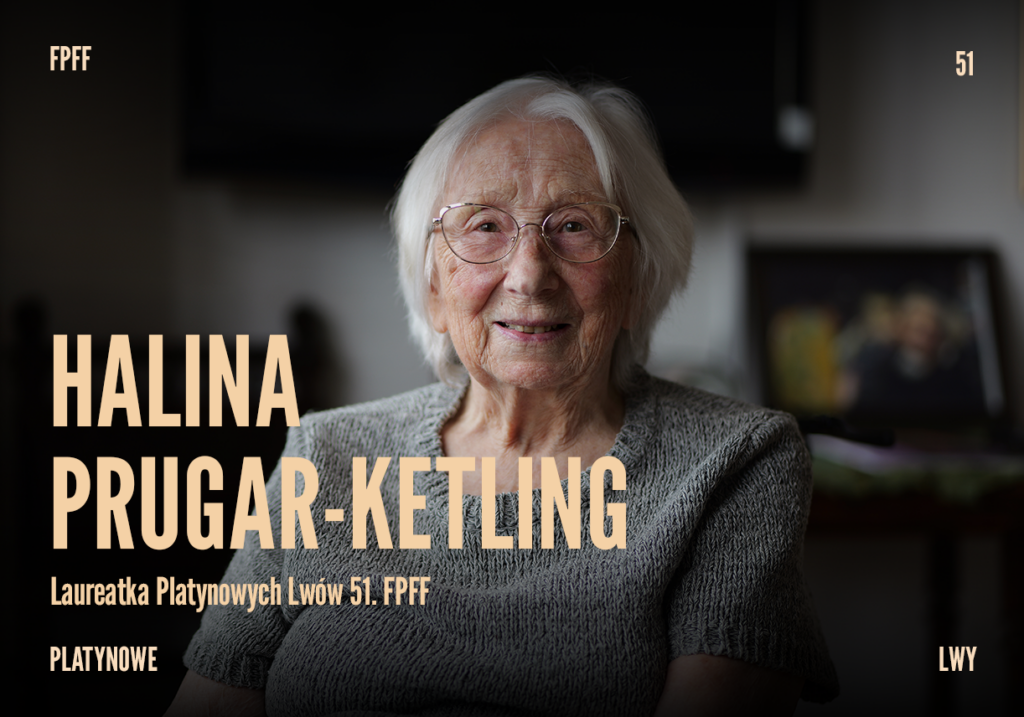
Halina Prugar-Ketling, an outstanding Polish film editor, will receive the Platinum Lions Award for lifetime achievement at the 51st Gdynia Polish Film Festival.
I am honoured by the decision to award me the Platinum Lions for my lifetime’s hard work. I accept this award with the utmost respect. I have always strived to ensure that the films I have created are received by the audience exactly as I intended them to be seen. Some required a fast pace, whilst others called for a subtle narrative. But they always had to be accessible and stir emotions – comments the winner, Halina Prugar-Ketling.
When asked about her work, Halina Prugar-Ketling speaks of the rhythm, the mood of the scenes and the emotions she wanted to share with the audience. The impressive body of work by this year’s Platinum Lions winner is nothing short of awe-inspiring. One thing is certain – without Halina Prugar-Ketling’s exceptional cinematic intuition, Polish cinema would not be the same. And that is precisely what we will be discussing during this year’s edition of the festival – emphasises Artistic Director Joanna Łapińska.
Director Łukasz Ronduda, Chair of the PFF Programme Council, comments on the choice of the laureate: Ms Halina Prugar-Ketling is a legend, a titan of Polish cinema. It is hard to describe in any other way a person who, since the 1950s, has worked consistently with the most outstanding filmmakers in Polish cinema. Ford, Żuławski, Zaorski, Konwicki, and in particular Wajda, owe the final form of their most outstanding films to her. It is high time that Ms Helena’s enormous contribution to the history of Polish art cinema was recognised and appreciated. What is more, the Platinum Lions awarded to this doyenne and master of film editing highlight the importance of this profession and its crucial role in the filmmaking process. Film editors are now beginning to assert themselves and fight for the rights they are due. This award also supports their efforts.
Halina Prugar-Ketling (born 1929) is one of Poland’s most distinguished film editors, having been involved in cinema since the early 1950s. Over the course of more than forty years, she has edited over a hundred documentaries, feature films and television productions. She has collaborated with iconic figures of Polish cinema, including Aleksander Ford, Janusz Morgenstern, Roman Polanski, Jerzy Skolimowski, Andrzej Żuławski, Janusz Zaorski, Janusz Kijowski, Filip Bajon and, above all, Andrzej Wajda, with whom she worked closely from the late 1960s. and edited such masterpieces by this director as Everything for Sale (1968), The Birch Wood (1970), The Wedding (1972), The Promised Land (1974), Man of Marble (1976), Without Anaesthesia (1978), The Maids of Wilko (1979), Man of Iron (1981) and Danton (1982). She also edited outstanding films by other directors, such as Five from Barska Street (1953) and The Eighth Day of the Week (1958) by Aleksander Ford, Knife in the Water (1961) by Roman Polanski, Barrier (1966) by Jerzy Skolimowski, The Third Part of the Night (1971) by Andrzej Żuławski and Soccer Poker (1988) by Janusz Zaorski.
Her career began at the Documentary Film Studio, where she worked on the Polish Film Chronicle series. Initially, she worked as an assistant editor to Wacław Kaźmierczak, then to Wojciech Jerzy Has, before going on to become an independent editor of documentary and feature films. She has received significant honours for her achievements: an individual Award from the Chairman of the Committee for Radio and Television for her editing of the series Polskie drogi (1978), the Bronze Medal for Merit to Culture – Gloria Artis (2016) and the Polish Filmmakers Association Award for outstanding artistic achievements (2023).
Halina Prugar-Ketling’s body of work occupies a permanent place in the history of Polish cinema. She played a significant role in shaping the language of editing in post-war Polish cinema. The experience she gained whilst editing newsreels and documentaries shaped her unique sense of rhythm, drama and narrative. She herself emphasises that editing is a process of ‘rewriting’ a film – it is in the editing room that a work gains its emotional meaning and the right pace. Good editing remains invisible, subordinating every cut to the emotional truth and internal logic of the story. Intuition, the ability to choose the right shot, and close collaboration with the director – based on dialogue and mutual trust – are of key importance to her. This is precisely how her collaboration with Andrzej Wajda unfolded, for whom Halina Prugar-Ketling was a creative partner.
During the Festival, a series of events centred on the laureate’s work will take place. Andrzej Wajda’s film The Maids of Wilko will be screened – a title chosen by Prugar-Ketling herself as an example of her favourite production. Film critic Łukasz Knap and editor Rafał Listopad will lead a masterclass on behalf of the laureate, during which they will examine her work from several perspectives: biographical, artistic and technical. They will discuss her life, working methods, editing style and the unique role she played in shaping the language of Polish cinema. Although the award-winner will be unable to attend the event in person, the masterclass will serve as an opportunity to engage with her voice, experience and body of work. The session will be illustrated with excerpts from the most significant films she has edited, as well as excerpts from an interview conducted by Łukasz Knap with the artist as part of the “Notacje archiwalne” series produced for the Polish Filmmakers Association.
The 51st Gdynia Polish Film Festival will take place from 21st to 26th September 2026. The festival is organised by the Pomeranian Film Foundation in Gdynia.
