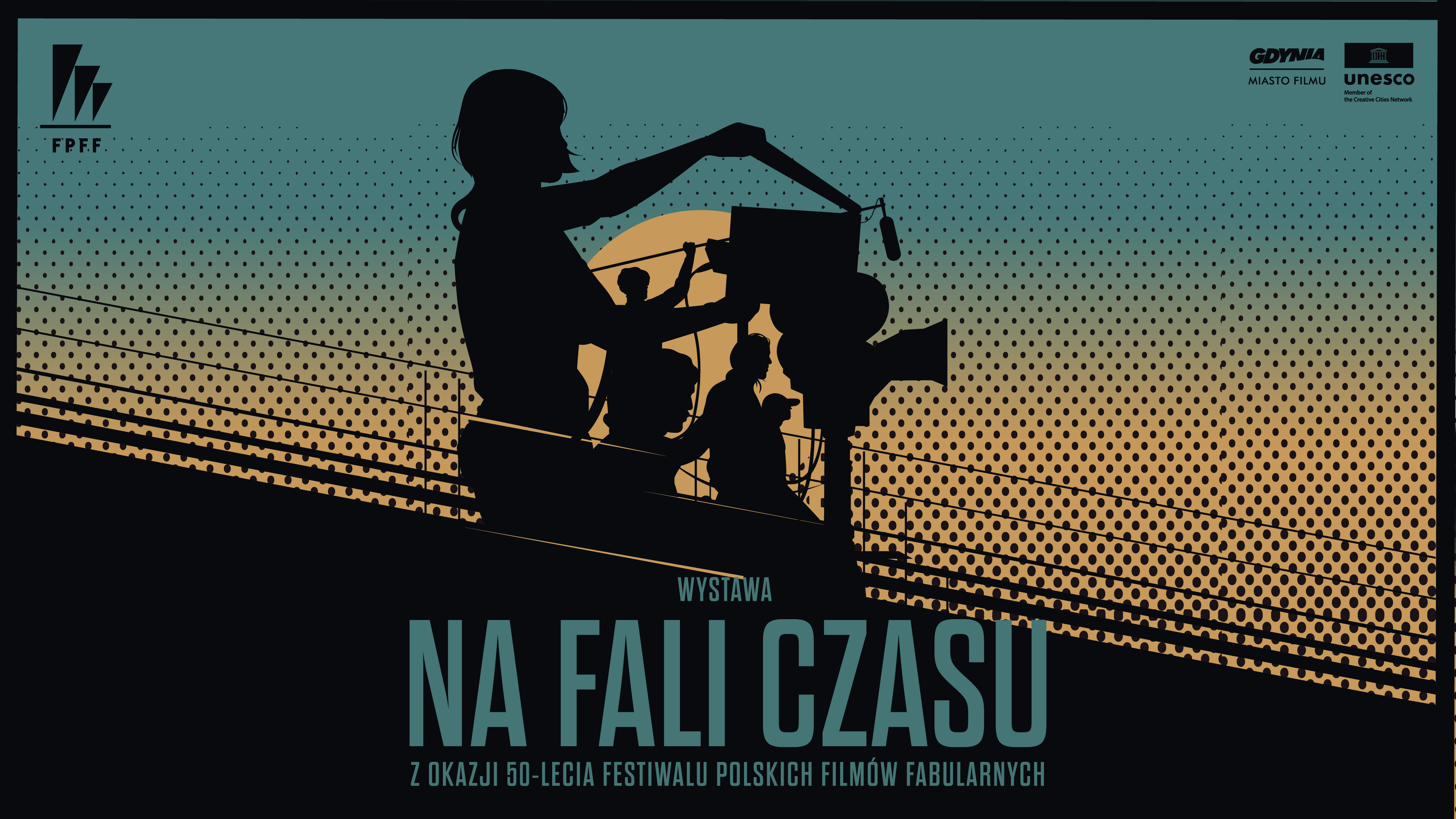
Catching the Wave of Time is a narrative exhibition tracing the fifty years of history of Poland’s most prestigious film event: the Gdynia Polish Feature Film Festival. It was inaugurated on the opening day of the 50th edition of the festival at the Gdynia City Museum, where it remained on display until January 2026.
Spanning half a century, the story begins with the passion for cinema of the Festival’s first Director, Lucjan Bokiniec, and of those associated with the Film Discussion Club – Żak in Gdańsk. An atmosphere of conversation, music, openness, and fascination with film and its creators. A grassroots initiative that arose from the need to create a space for people to meet, to promote the younger generation of filmmakers, and to engage with the audience. Having travelled a long way from Sopot and Gdańsk to the Musical Theatre in Gdynia, the Festival continues to seek a contemporary perspective on Polish cinema, serving as a key hub for the film industry and the next generation of filmgoers.
Through the exhibition’s narrative, we travelled back in time to revisit the most significant figures, events, award-winning films, the atmosphere of the Festival and its behind-the-scenes moments. The wave of time flows from the contemporary magic of the red carpet to the struggle for self-determination and artistic freedom in Poland’s film industry during the communist era. Major political events and micro-stories linked to the personal experiences of each participant.
We looked at the Festival through the eyes of the organisers, filmmakers and, above all, the audience. It was they who spoke of their experiences and emotions, from which emerges a picture of this incredible event, which has been sparking interest and controversy for years. The Festival is, after all, an opportunity to meet, a chance to talk about film and about the present day. It is a chance to share one’s feelings and experiences, as well as to reflect on the extent to which film shapes our view of the reality around us. It is also a confrontation – with the audience, with critics, with film enthusiasts, and ultimately with politics.
“The main aim was to create an exhibition that could take many different forms. The exhibition consists of twelve modules, each devoted to a single major theme, which together form a broad and comprehensive narrative about the Festival. “We wanted this format to allow us to extend the celebrations of the 50th anniversary and, in the years to come, to be able to present individual modules and use them to create different variations on the history of the PFF,” says Agata Kozierańska-Burda, Managing Director of the Pomeranian Film Foundation in Gdynia and the exhibition’s initiator.
The exhibition provided an opportunity to showcase previously unpublished documents, memorabilia and photographs. Magnificent awards prizes, including the famous Golden Lions statuette, which has changed its form over the years. Graphic elements and original artefacts were woven into a multimedia spectacle, featuring film footage that brought the atmosphere of the Festival to life. The history of the event is not uniform, and each edition has its own character and significance in terms of its impact on Polish cinema. It is not just about the glitz, but also the shadows; hence the exhibition is not arranged chronologically, but presents the most important developments – and often difficult topics – in a thematic manner.
Above all, the exhibition is a nostalgic journey to the places and people whose dedication and hard work have meant that, for half a century, we have been able to enjoy the magic of Polish films. The exhibition has demonstrated that, despite the passage of time, one thing remains unchanged in Gdynia – the love of cinema.