

The birth of the Polish Film Festival was the result of several important phenomena. The Festival's founder organized the Polish Film Debuts review. The successes of Polish cinema stimulated the development of film criticism, and meetings with filmmakers and Film Discussion Clubs became popular. One of these was the Gdańsk Film Discussion Club "Żak", where Lucjan Bokiniec, later the founder and first director, organised the Polish Film Debuts review.
At the same time, the film community was consolidating. The establishment of the Polish Filmmakers Association in 1966 created a platform for defending filmmakers against government pressure, but also revealed the need for a forum for discussion about the state of Polish cinema. The previous festival in Łagów no longer fulfilled this role.
What was missing was an event that would simultaneously be a celebration of Polish cinema, an annual review of domestic production, and a space for meetings and debates – modeled on the most important European festivals.
In 1974, these needs resulted in the establishment of the Polish Film Festival in Gdańsk. Interestingly, the competition films were shown in cinemas in Sopot. Subsequent editions, until 1986, became permanently associated with Gdańsk, and their symbol became the Golden Lions of Gdańsk, which remain a reminder of the Festival's roots to this day.
The 1970s were marked by two distinct trends. On the one hand, spectacular historical and costume productions such as Jerzy Hoffman's The Deluge, Jerzy Antczak's Nights and Days, and Andrzej Wajda's The Promised Land were all triumphant. On the other, a cinema of moral anxiety, tackling important social and political themes, was gaining in importance.
It was then that the Festival began to become a place of open confrontation between filmmakers and the authorities. A symbolic event was the omission of Wajda's Man of Marble from the jury's verdict for political reasons. The Grand Prize was awarded to Krzysztof Zanussi for Camouflage, but the director refused it in a gesture of solidarity with Wajda. The director of Man of Marble received a symbolic brick from the journalists.
This was even more pronounced during the Polish Filmmakers Association Forum in 1977. The community openly protested against the policies of Minister of Culture Janusz Wilhelmi, who sought to subordinate cinematography to the government. Although the protests failed to produce the desired results, the Festival became a lasting platform for the fight for freedom of artistic expression.
-
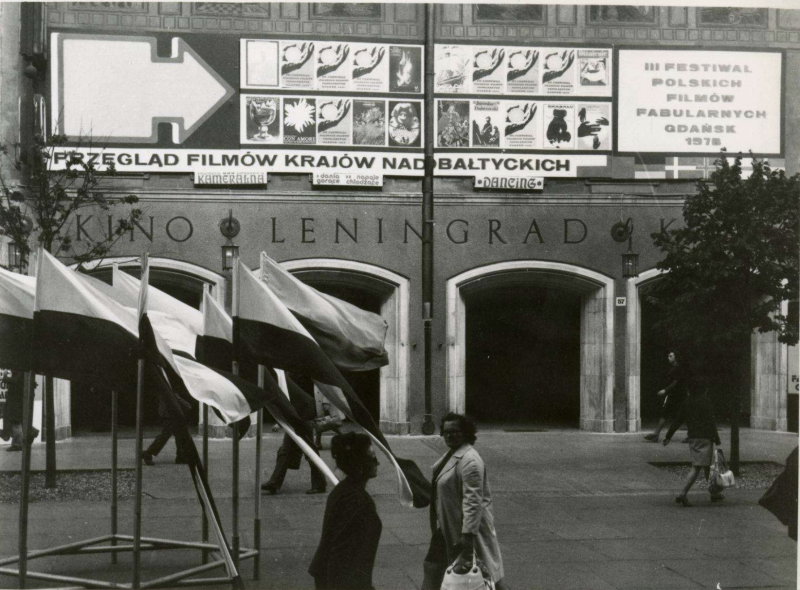 Leningrad Cinema at the 3rd PFF in 1976
photo Janusz Gojke -
A festival in the shadow of history
The 1980s were one of the most turbulent periods in the festival’s history. They brought a time of hope, a period of stagnation linked to martial law and the move to Gdynia, and finally the prospect of political changes that transformed Polish cinema forever.
In 1980–1981, the competition featured for the first time ‘shelved films’ – that is, films previously banned by the censors – including Janusz Kijowski’s Index, Krzysztof Kieślowski’s The Calm and Jerzy Skolimowski’s Hands Up!. A new generation of filmmakers made their festival debut, including Barbara Sass and Piotr Szulkin, whilst Agnieszka Holland became the first woman to win the main prize for her film Fever.
In 1982, following the imposition of martial law, Minister Józef Tejchma decided to cancel the festival. The event did not return until two years later.
Since 1984, the festival has reflected the divisions in Poland at that time. Official screenings took place at the NOT in Gdańsk, whilst St Nicholas’ Church became the informal meeting place for the film community. The competition featured films by acclaimed masters, young filmmakers depicting contemporary life, and ambitious genre cinema.
Some of Polish cinema’s biggest hits also date from this period: Sexmission, Big Shar and H.M. Deserters . Cinema aimed at young audiences also flourished – Krzysztof Gradowski’s films about Mr. Kleks, Stanisław Jędryka’s original productions, and Kazimierz Tarnas’s film adaptations of Kornel Makuszyński’s prose have left a lasting impression on successive generations of viewers.
-
 fot. Janusz Gojke


