- venue: Plac Grunwaldzki, Gdynia
- dates: 21st-26th September 2026
- free admission
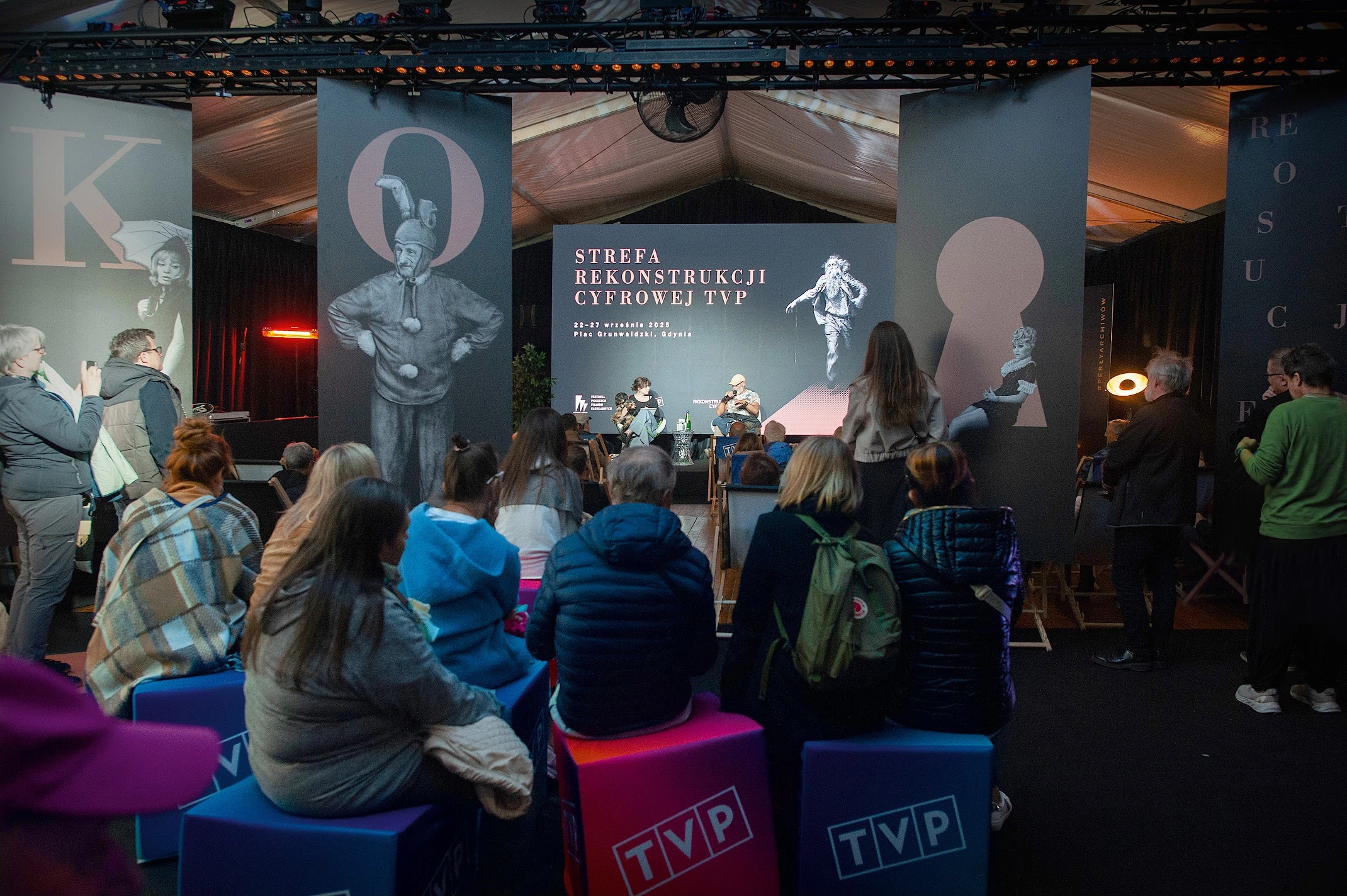
During the 51st Polish Film Festival the TVP Digital Reconstruction Zone will become a place for experiencing the richness of the Archive of Telewizja Polska. Join us in discovering the forgotten classics of Polish film and Television Theatre, and historically groundbreaking television materials. Thanks to digital reconstruction a lot of them were brought back with restored image and sound quality.
This year, a special place in the programme will be held by two of the Polish cinema greats – Andrzej Wajda and Krzysztof Kieślowski. We will pay tribute to both their films and plays created for television.
We will launch the zone with a day dedicated to Andrzej Wajda, whose 100th birthday we will be celebrating in 2026. We will be screening, amongst other things, the play Interview with Ballmeyer (1962) and the films Miss Nobody (1996) and Wielki Tydzień (1995). On Friday, we’ll be taking a look at the work of Krzysztof Kieślowski – we’ll be screening his television play Kartoteka (1979), the films Dekalog: 5 (1989) and Dekalog: 6 (1990), and we’ll also be hosting an open discussion panel entitled “Krzysztof Kieślowski – the cinema of mindfulness”.
From Monday to Friday, between 9.00 a.m. and 12.00 p.m., the Zone will host workshops for primary and secondary schools, led by film educator Anna Równy. In the afternoon, the space will be open to all festival guests. The programme will feature screenings of Television Theatre productions, archive television programmes and the #PerłyArchiwów and #PierwszyPlan podcasts, which offer a glimpse behind the scenes of Polish film and television and bring to life the people, events and stories preserved in the TVP archives.
The evening re-releases of the restored films will be accompanied by lectures on their history, providing a different viewing perspective, by film experts Anna Równy, Joanna Najbor and Diana Dąbrowska. This will serve as an opportunity to rediscover digitally reconstructed movies like Niespotykanie spokojny człowiek (1975) S. Bareja, Polish Death (1994) W. Krzystek, Nothing (1998) D. Kędzierzawska, Temptation (1995) B. Sass-Zdort or White Marriage (1992) M. Łazarkiewicz.
The Zone’s programme will be complemented by Television Theatre productions – including Dudek (1964), directed by Jerzy Antczak, and Helver’s Night (2000) by Barbara Sass-Zdort – as well as a special panel discussion entitled ‘Krzysztof Kieślowski – the cinema of mindfulness’. As a result, the Zone will not only serve as a venue for the screening of digitally restored material, but above all will provide an opportunity to discuss film, its history, and how archival works can resonate with successive generations of viewers.
On Saturday morning, we invite the youngest viewers for a cinematic meeting with dragons in the animated Sceny z życia smoków (1994-1997). Later in the day, we will be screening Wojciech Jankowski’s archive-based documentary Czas Gdyni (1986) and two films by Andrzej Barański: Dwa księżyce (1993) and Dzień wielkiej ryby (1997).
A detailed programme is available in the TVP Digital Reconstruction Zone on Grunwaldzki Square.
Telewizja Polska is a long-standing partner of the Polish Film Festival in Gdynia, as well as a leader in the field of digital restoration and the provision of access to archival audiovisual resources. In one of the largest and most state-of-the-art digitisation studios in the country, TVP is restoring iconic works of Polish cinema to their former glory. More and more restored cinematic and television masterpieces, which form the canon of Polish cinema, are being added to the extensive digital television library. These unique collections are available free of charge to all viewers on the vod.tvp.pl and cyfrowa.tvp.pl websites, where we combine cinematic tradition with modern distribution.