
The Colours of “Chance”: Krzysztof Kieślowski’s Lasting Legacy in Contemporary Cinema, From Documentaries, Passing by Three Colours Trilogy to Modern Italian Directors

FIPRESCI & Polish Film Festival Joint Publication on Krzysztof Kieślowski
The year 2026 marks the 30th anniversary of the great Polish director’s passing, and to honour his enduring artistic influence, FIPRESCI & Polish Film Festival prepared a special collection of seven essays written by international film critics associated with FIPRESCI. The publication aims to reflect on Kieślowski’s cinema and its continuing relevance for contemporary audiences, filmmakers, and critics around the world.
Michela Manente
Italy
Introduction: The geometric intersection of fate
Thirty years after the death of Krzysztof Kieślowski, the landscape of contemporary European art cinema still shows a persistent and deep presence of his formal and ethical structures. Far from being just an archive of 20th-century stylistic elements, the legacy to the Polish director has worked as an organizing principle in staging, a splitter of varied narrative paths, which finds one of its most fertile and complex expressions in contemporary Italian cinema.
Kieślowski’s artistic journey, shaped at the Łódź Film School - the Polish training institute where he took his first steps and shot his first essays - historically moved along a path of gradual transition from observational documentary to metaphysical fiction. In Poland during the 1960s and 1970s, documentary filmmaking was not just an informative genre, but mainly an artistic and politically independent one, an exercise in ‘living in the truth’ against the haze of communist state propaganda. It is within this framework of the ‘cinema of social unease’, and also moral unease, that the filmmaker’s perspective takes shape: a relentless rigor, seemingly anonymous but profoundly human, focused on revealing the mechanisms of power and where they hide, not through ideology, but by studying the intrusion of conscience into the paradoxes of everyday life. When economic restrictions and censorship in his country pushed his work toward relocating production to France and focusing co-productions in the West, this ethical demand turned into a universal ontological investigation. It was here in the nineties that the boundaries of global film geography were redefined, partly softening the divide between central and peripheral hubs of international production, also thanks to festivals that helped spread lesser-known cinemas. Among these, the Rotterdam Festival stands out, having discovered Kieślowski back in the seventies, long before he gained recognition at more prestigious festivals like Venice and Cannes. Although the director always said he wasn’t specifically inspired by any single filmmaker and wasn’t explicitly political, his move into fiction consistently questions the “trap of well-being”, the “paradox of choice” and the need for illusions.
In conducting this first investigation, Kieślowski looked up to the great masters of film history and expressed particular appreciation for two key figures in Italian cinema: the geometric precision of alienation in Michelangelo Antonioni (The adventure - L’avventura for Decalogue and Red Desert - Deserto rosso for Three Colours) and the humanist dreamlike quality of Federico Fellini, whom he studied from his time at the Łódź Film School, admiring The Road (La strada, 1954), from which he drew inspiration for some universal themes like existence, suffering, and human destiny.
The prototype of the chromatic drama: The architecture of Trois couleurs: Bleu
To understand Kieślowski’s contemporary influence, it’s necessary to look at the starting point of his Western turn: Three Couleurs: Bleu (Trois couleurs: Bleu, winner of the Golden Lion in Venice in 1993, tied with Robert Altman’s Short Cuts). The first chapter of Colour Trilogy, created in honor of the French motto Liberty, Equality, Fraternity, Three Colours: Blue is a fundamental and solid piece of the puzzle that focuses on emotions, death, and passion, linking them to colour symbolism. The film stages the unforgettable prologue of Kieślowski’s universal storytelling through the story of a painful journey undertaken by a young woman, Julie (Juliette Binoche, awarded the Volpi Cup in Venice for Best Actress). Having been made a victim of being separated from her loved ones due to the car accident that took away her husband and little daughter, Julie pursues a quest for freedom understood as denying the past and isolating herself in an anonymous apartment in Paris. However, the formal structure shows the impossibility of this existential self-sufficiency. To know who this woman is and who her husband was (it will turn out he was a famous composer and conductor who left unfinished a concert that Europe was waiting for), the viewer is led to let themselves be captivated by the music. The soundtrack, created by the Polish composer Zbigniew Preisner (who also composed the music for The Double Life of Véronique - La double vie de Véronique), is not just a commentary, but the very score of memory. From Julie’s search, preceded by a varied, explicit, and recurring symbolism, painful truths about the husband’s “other” lives emerge. The protagonist’s return to life is metaphorically represented by repeated dives into water, which, from immersive breath-holding, bring her back to breathing the air of her own existence. Julie thus experiences a path of gradual liberation where gaze becomes an experience of the gaze: at the height of desperate resignation from the attempted suicide, she rediscovers a freedom broken by a tragic fate but reclaimed with a strength equal to that of Joan of Arc. The Antonioni-like theme of incommunicability in Three Colours: Blue influenced the aesthetic of Nanni Moretti’s The Son’s Room (La stanza del figlio, 2001). Even though he has a decidedly personal stylistic signature, in portraying grief and the inability of family members to communicate their sorrow after the death of a child, Moretti clearly approaches the emotional sensitivity of Three Colours: Blue. There’s the same respect for silence, the isolation of characters in their own mental rooms, and the (strenuous) attempt to return to life through small everyday fragments. Another similarity in the processes of incommunicability can be seen in Giuseppe Tornatore (The Unknown Woman, La sconosciuta, 2006; The Correspondence, La corrispondenza, 2016). Tornatore shares with Kieślowski the attention to invisible bonds, intertwined destinies, and unspoken secrets. In The Unknown Woman, the drama of the past and the existential loneliness of the protagonist Irene (Ksenia Rappoport) closely resemble the hermetic isolation of Julie, made livelier by an international intrigue. In The Correspondence, the central theme is precisely the lack of communication mediated by technology and the physical absence of the other, combined with a strong presence of the soundtrack as a narrative element (a clear legacy of the partnership between Kieślowski and composer Zbigniew Preisner). Moving on to The Consequences of Love (Le conseguenze dell’amore) by Paolo Sorrentino (2004): Titta Di Girolamo (Toni Servillo) lives in a hotel in Switzerland, locked into a geometric routine and in tomb-like silence. He is the embodiment of incommunicability and the refusal to live in order to protect himself from pain. Visually, Sorrentino uses precise shots, geometries, and highly stylized cinematography that closely mirrors the formal rigor Sławomir Idziak brought to Three Colours: Blue. In Happy as Lazzaro (Lazzaro Felice, 2018), her third feature, Alice Rohrwacher touches on the same theme. Even though Rohrwacher’s style leans more towards magical realism, there’s a profound element she shares with the Polish director: the spiritual and ethical dimension of the “pure” characters who can’t communicate or make themselves understood by a cynical society. Rohrwacher, like Kieślowski, films the invisible and the movements of the soul through matter and details, eventually directing her latest film made of rarefactions on a current theme, that of commissioned art theft, like The chimera (La chimera, 2023). Firmly rooted in this vein, Alice Rohrwacher will direct the film adaptation of Italo Calvino’s The Baron in the Trees, an author with whom the Polish director shares the theme of a divergent perspective on analyzing the world, along with a deep dive into the existential complexity of human desire.
The Italian constellation: synchronicity, realism, and transcendence
The influence of this realism cinema that becomes metaphysical has found a deep ground for reinterpretation in contemporary Italian cinema, surpassing the historical tradition of political and civil cinema of the Seventies and Eighties. While directors like Francesco Rosi (with whom Kieślowski shared work in the documentary field, socio-political commitment, philosophical analysis, and a deep dissatisfaction when facing reality, expressed in masterpieces like La sfida and Le mani sulla città) and Elio Petri had explored power as a top-down structure identified in the State and law enforcement, the arrival of Kieślowski's cinema in Italy shifts the focus toward a social unease represented by the chiaroscuro of the human soul, which had become the chiaroscuro in the cinematography of the Decalogue (Dekalog) shorts. A tangible link in this cultural transition is represented by the Polish actor Jerzy Stuhr, a key collaborator known in the national theater, for whom Kieślowski wrote The Amateur, and who starred in films from his early work, offering his own perspective on Polish life under communism, such as The Scar (first feature, 1976, he plays the assistant to director Bednarz) and Calm (TV film, 1976, he plays a young man coming out of prison after serving a short sentence), as well as being cast in episode 10 of the Decalogue and in one of the Three Colours: White. Stuhr, an actor also skilled in the Italian language, was symbolically chosen by Nanni Moretti for the role of the Polish ambassador in his film Il sol dell’avvenire (2023), visually highlighting the persistence of this connection that began on the set of Il caimano (2006) and was reinforced in Habemus Papam (2011), where he played the role of the Polish spokesperson for the Holy See, Marcin Raijski. Today, the “ghost” of Kieślowski resonates among a wider range of Italian filmmakers who have redefined the turning point of national cinema, engaging with reality through imagery and the intrusion of consciousness.
Paolo Sorrentino’s Secular Spirituality
Paolo Sorrentino, who brought Italy back to winning an Oscar with The Great Beauty (2013), inherits from Kieślowski a fascination with the metaphysical and the exploration of the sacred and the profane in a secularized dimension. The visual opulence and existential emptiness explored in The Great Beauty, together with the traumatic pain in The Hand of God, closely echo the atmospheric melancholy of Three Colours: Blue and the visual obsession with fate and suffering that also characterizes The Double Life of Véronique (1991). Sorrentino shares with the Polish master a stylistic inclination for the use of transcendent music, used to reveal the invisible forces of chance that govern human lives. The soundtrack stops being an external element and becomes the balancing point that guides the characters within a dark satire and existential contrast, where private trauma turns into a universal inquiry into the meaning of loss.
Pietro Marcello’s poetic realism
Pietro Marcello’s cinema (director of Martin Eden, 2019, freely adapted from Jack London’s novel) faithfully reflects Kieślowski's ability to blur the lines between documentary truth and lyrical fiction, capturing the temporal fluidity and poetic realism of the Warsaw director. Marcello adopts an extremely fluid treatment of time and memory, allowing the weight of historical and social constraints to collide with the poetic and fragile destinies of his characters. In this kind of storytelling, archival memory merges with intimate human dramas, just as it did in Kieślowski's early films, where observing social reality never excluded the lyrical element. The camera serves a historical reconstruction that is, first and foremost, an experience of the soul, where the paradox of choice and the necessity of illusions guide the characters' paths toward their inevitable encounter with fate.
Gianfranco Rosi’s ethical camera
Directly recalling Kieślowski’s roots as a rigorous documentarian in the 1960s and 70s, Gianfranco Rosi's cinema (creator of works like Fire at Sea - Fuocammare - and Notturno) embodies the moral imperative of the Polish director. Rosi’s documentary approach is based on patient observation of marginalized realities and human tragedy, carried out in a rigorous and non-judgmental way. This method elevates the documentary form to a universal and spiritual investigation of suffering, closely aligning with the philosophical depth of the Decalogue. For Rosi, as for the early Kieślowski who loved handling the camera (his 1968 short film Photography is a tribute to this), the camera acts as a true ethical tool: an aesthetic device capable of revealing the invisible metaphysical links that connect human pain and showing the human condition in its most authentic chiaroscuro. This attitude can also be found, with different nuances, in the raw and realistic but non-judgmental style that Matteo Garrone uses in films like Gomorra (2008) or Dogman (2018), where, like in the works of the Polish master, there isn’t a black-and-white view of good and evil, or in the human dynamics explored by Leonardo di Costanzo in the clash between the ambiguity of the human soul and institutions (for example, prison in The inner cage, Ariaferma, 2021 and Elisa, 2025), confirming how widespread this ethical stance is.
Conclusions: The vital model of introspective restlessness
The path traced shows that Krzysztof Kieślowski’s legacy in contemporary Italian cinema isn’t just about sterile formal references; instead, it acts like a vital lifeblood that fuels some of today’s cinematic perspectives. From Paolo Virzì’s films focusing on precarious work and labor inequalities, like A Whole Life Ahead (Tutta la vita davanti, 2008) and Human Capital (Il capitale umano, 2013), to the international heights reached by Luca Guadagnino with Call Me by Your Name (Chiamami con il tuo nome, 2017) and After the Hunt (After the Hunt - dopo la caccia, 2025), the existential themes of the Polish master continue to provide guidance for interpreting a society struggling with the past, totalitarianism, and new visual or economic regimes. Thirty years after his passing, when facing the ontological dilemma that was already Pier Paolo Pasolini’s in exploring the relationship between man and society (Teorema, 1968), though more focused on the sacred-profane pair, Kieślowski’s cinema remains an essential model for modern filmmakers dealing with the fragmentation of existence. Through the eruption of consciousness, chromatic symbolism, and the decoding of reality mediated by the skillful use of visual language, contemporary Italian authors continue to move in the groove of that masterful lesson: turning the colours of chance into the necessary trajectories of art. We also owe the Polish director for the unrealized trilogy dedicated to Dante Alighieri’s The Divine Comedy, which was supposed to be created as three feature films, each devoted to Inferno, Purgatorio, and Paradiso.
Michela Manente, film critic, journalist and poet, writes film criticism and composes essays, reviews and articles about news, culture, and lifestyle for various magazines (Messaggero di Sant’Antonio - national and foreign edition, Carte diCinema, mostradelcinema.net, quartopotere.com, cinecriticaweb.it). She attends the main Italian festivals (Venice, Turin, Rome, Trieste, Udine, Bergamo, Bologna) from where she reports on new films. The main genres she focuses on are fiction and both Italian and International documentaries; she engages with cinema’s protagonists by interviewing them and exploring artistic vision and themes. Recently, she has been a jury member for National Syndicate at Reggio Calabria, Lago Film Fest, Sulmona International Film Festival, Pordenone Docs Fest, and for Fédération Internationale de la Presse Cinématographique at El Gouna Film Festival (Egypt), Regard Festival (Saguenay, Canada), Ljubljana International Film Festival (Slovenia), Schlingel International Film Festival (Chemnitz, Germany). She is a member of Italian Journalists’ association, Fipresciand SNCCI Triveneto.
-
 Gazeta Festiwalowa numer 7
 -
 Październikowe odsłony „50 na 51”
 -
 Srebrny Festiwal. FPFF dla osób starszych
 -
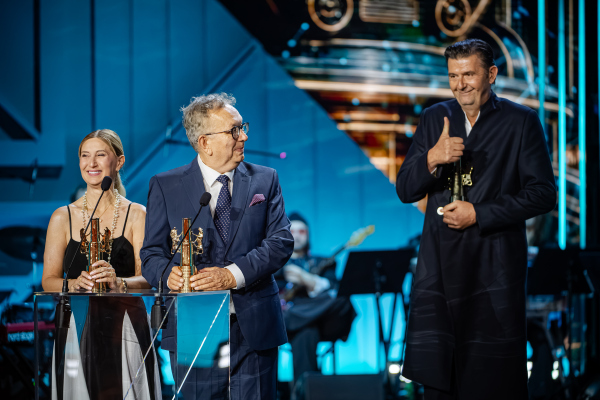 Closing Gala of the 51st Polish Film Festival – photo report
 -
 RED CARPET – photo report
 -
 Day six of the 51st PFF – photo report
 -
 WINNERS OF THE 51ST PFF
 -
 What’s in store for today? SATURDAY
 -
 Festival Newspaper No 6
 -
 51st PFF Newsreel - Episode 5
 -
 Horror lies underneath
 -
 The Apostles of Rock’n’Roll.
 -
 Notions of Intertextuality in the Cinema of Krzysztof Kieślowski
 -
 The architects of chaos. How do women backstage at the PFF save the celebration...
 -
 YOUNG GALA – photo report
 -
 Day five of the 51st PFF – a photo report on festival life and accompanying...


